Starting RAID: Shadow Legends can feel overwhelming with the number of systems and materials. This guide focuses on practical progression milestones for new players in their first 30 days, laying out what to do after you pick your starter and how to build a compact, effective early team.
It differentiates official game progression concepts from community strategies, and it points you toward concrete actions each time you log in. For deeper starter comparisons, see the Respawn Daily beginner content and the starter Champion comparison when you need a quick reference on synergy and roles.
What to do immediately after choosing a starter
Your first session should establish a solid foundation for growth. Priorities are: (1) identify your starter’s role (damage, support, debuffer, control), (2) set your early campaign path for steady XP, gear, and ascension mats, and (3) confirm your initial team focus. Do not rush to level every champion; instead, plan a small core that will carry you through the first acts of campaign and the first Clan Boss attempts.
Starter Alignment Checklist
- Identify your starter’s role (debuffer, multi-hit, poison, or AoE).
- Note potential synergies or counters with common early content.
- Join a clan or set up access to Clan Boss/Doom Tower as soon as possible.
- Refer to starter-specific guidance for expectations vs alternatives (Kael, Athel, Elhain, Galek).
| Detail |
|---|
| Check if you have compatible ascension materials. |
| Assess starter’s impact on current content (campaign, early dungeons, clan boss). |
| If a non-starter offers faster progress, consider delaying starter Rank 6 until core is ready. |
First Rank 6 / level 60 decision
Rank 6 is a major milestone. Decide based on content access and material availability in your first weeks. Official progression requires catalysts and basic ascension mats that become accessible through campaign and early dungeon farming. If your starter’s performance in early content is strong enough to clear daily campaign and handle an archetypal team role, Rank 6 it when you have the necessary materials and a clear advantage in the next content tier. If materials are tight or you’re lacking synergy with another champion, consider postponing Rank 6 until you can form a reliable core.
When to 1st Rank 6 the starter vs bring in another Champion
| Detail |
|---|
| If starter covers a unique role you lack and you can support with mats, prioritize its Rank 6. |
| If another champion unlocks faster progression (debuffs, control, or wave clear), consider introducing them first. |
| Avoid over-investing before a clear core emerges. |
Practical rule: prioritize the starter if they provide a unique role your team lacks (for example, a dependable debuffer or a high-control nuker) and you can obtain the ascension materials within a reasonable time. Bring in a second Champion when the starter’s role is well-covered by a complementary partner (e.g., another damage dealer to share kills, or a finisher to enable sustained fights). Early on, a second Champion can unlock new dungeon routes and improve campaign stability, but avoid over-investing in a large roster before core synergy and material flow are solid.
Campaign progression and farming
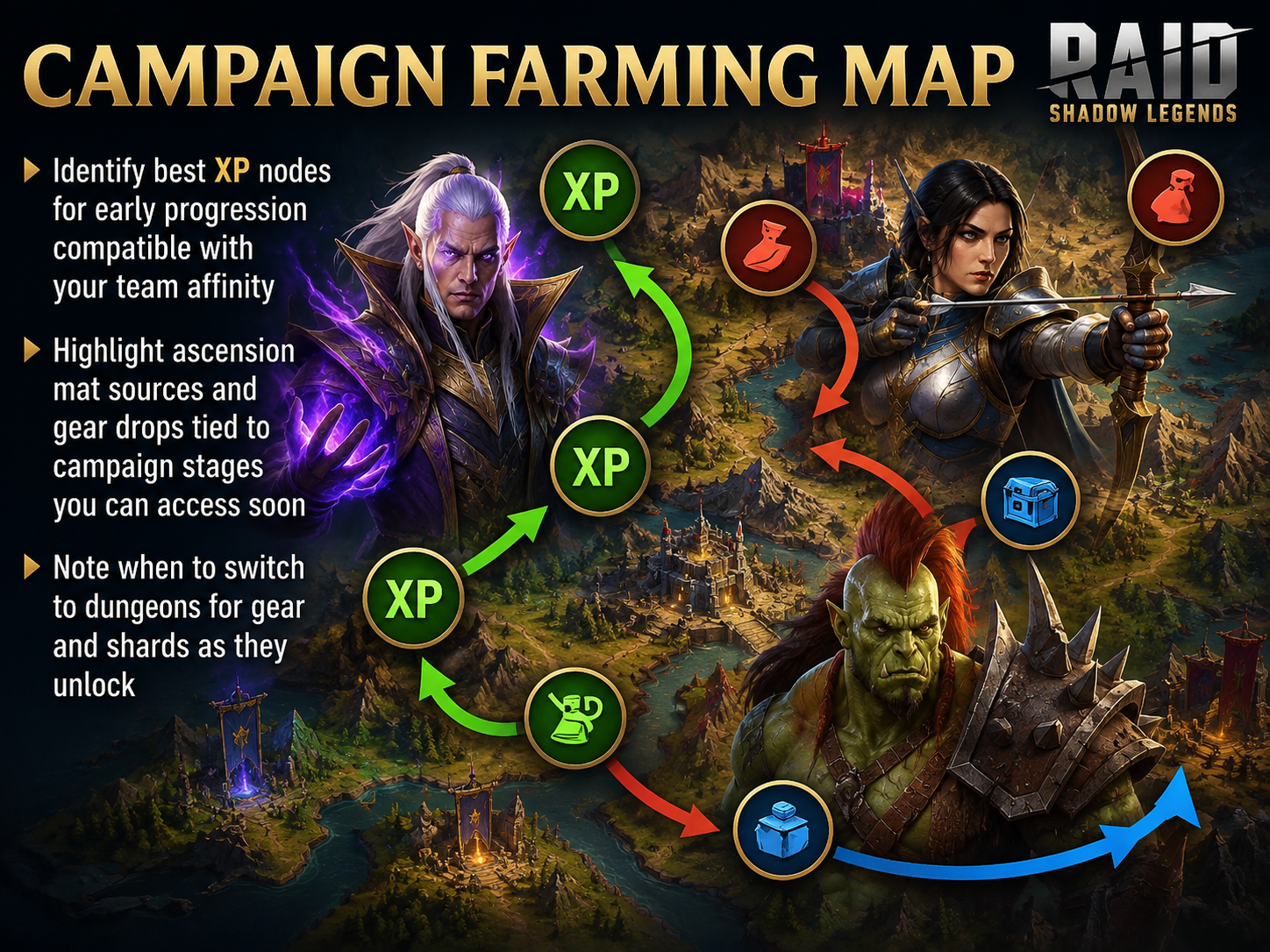
Focus on steady XP through Campaign nodes that yield ascension mats and XP scrolls. Prioritize bosses that drop relevant gear and rare ascension materials for your core team. Use dungeon farming routes that align with your affinity and gear needs to access speed, crit, and debuff gear. Efficient farming means planning routes that minimize downtime and maximize material yield per energy.
Campaign Farming Map
Building the first core team instead of leveling too many Champions
A compact 2–3 champion core is the most efficient path early on. Choose champions with complementary roles and strong synergy (e.g., one damage dealer, one debuffer, one healer or control). This approach improves clear speed, reduces material drain, and makes arena and dungeon progress more predictable. Avoid spreading XP and ascension mats across a wide roster before you have a dependable backbone.
Early gear and upgrade priorities
Prioritize speed as a primary stat if your core team relies on turn order, followed by crit for damage dealers and debuffs for control champions. When upgrading gear, aim for affinity-appropriate sets and basic ascension. Stockpile or farm gear with substats that support your core roles, and upgrade weapons and accessories that directly increase your team’s performance in the first acts of campaign and early dungeon runs.
Masteries and Skill Tome priorities
Choose masteries that bolster survivability and core damage for your early team. Prioritize options that improve longevity (defense, HP, revives) and reliable damage amplification. As you unlock more, adapt masteries to content needs (Clan Boss, Demon Lord, and dungeons) while planning to shift tomes toward your core’s most impactful skills.
Demon Lord / Clan Boss progression
Progression milestones in Demon Lord and Clan Boss provide practical shard farming and gear practice. Start with modest Clan Boss runs to learn timing and rotations, then push to more challenging waves or higher difficulty as your team strengthens. Shard farming through these modes can support early ascensions and general progression.
When to begin pushing Dungeons
Begin Dungeon farming once you have a reliable core that can consistently clear the floor you target and you’ve secured basic gear upgrades. Early dungeons unlock essential sets and resources. Use them to fill gaps in your core team’s speed and survivability, while avoiding over-parming a single champion too early if the team isn’t ready.
Arena priorities
In the Arena, focus on matchups that reflect your core’s strengths. Prioritize battles that test your core synergy and help you earn weekly or daily rewards without over-investing in niche teams. The goal is steady progress and shard opportunities, not perfection in every matchup.
Resource management: Energy, Silver, Gems, Shards and Chickens
Conserve energy and silver for essential ascensions, gear upgrades, and skill tomes. Use gems for life-sustaining care like energy refills during prime farming windows or to speed important builds, and consider shards only as needed for gear or champion acquisition. Chickens (for feeding) should be managed to avoid unnecessary churn; prioritize saves for champions you plan to ascend.
Common mistakes that slow account progression
Overleveling many champions without a plan, chasing gear with poor stats, and neglecting ascension mats are common bottlenecks. Another frequent issue is mismanaging energy by farming suboptimal routes. Stay focused on your core team and the materials that directly support your milestones.
A practical Day 1 → Week 1 → Week 2 → Day 30 roadmap
- Day 1: Pick a clear core, set campaign route, identify ascension mats path, and plan your first dungeon or clan boss goals. - Week 1: Rank up either the starter (if you have the mats) or bring in a complementary second Champion. Establish initial gear upgrades and mode-specific priorities (campaign and early dungeon routes). - Week 2: Solidify core team synergy, push small Clan Boss or Demon Lord milestones, begin light Arena testing, and adjust gear sets for speed and debuff efficacy. - Day 30: Have a stable core team (2–3 champions) with ascension paths defined, established dungeon routes, and a clear plan for ongoing gear upgrades and mastery shifts.
Concise early-game checklist
- Define your 2–3 champion core and their roles. - Map a sustainable campaign route with early ascension targets. - Gather ascension mats and basic gear aligned to your core. - Choose masteries and skill tomes that support survivability and core damage. - Establish a Clan Boss and Demon Lord progression plan for shards. - Set Arena goals that reinforce core growth. - Manage energy, silver, gems, shards, and chickens with a focus on core progression.